


















For too long, senior marketers and marketing operations leaders have been chasing the ‘single view’ of the customer. However, data silos often prevent a unified profile, even when systems hold a wealth of data. In response, this article explores why previous attempts failed. Furthermore, it shows how Adobe RT-CDP B2B Edition provides the foundation for a connected, revenue-accelerating organization.
The B2B Data Fragmentation Challenge: The ‘Single View’ Myth
For a decade, the C-suite expected CRM systems to deliver a unified customer view. In reality, these systems often became static repositories for sales logs. The reality, however, is that these systems became little more than static repositories of sales logs and lead contact details. They only capture a fraction of the total engagement story. Today, they are struggling with privacy regulations and the end of third-party cookies.
The consequence is a persistent state of mis-information across the organization. Marketing sees an anonymous cookie identifier, sales sees a contact record from six months ago, and customer success sees a support ticket. Each team operates on a fragmented snapshot, leading to wasted spend, disjointed experiences, and frustrated buying groups.
Why the B2B Customer is not a single row
The fundamental flaw in this traditional approach is a category error for B2B. A ‘customer’ is not a single row in a database. Instead, it is a dynamic, shifting web of stakeholders. This group includes:
- A buying committee, which can include a VP of Finance, a Head of Operations, and an IT lead to make a decision on buying software.
- Individuals that interact with your business through different channels, at different times, and with different levels of anonymity. One person might be a known lead in Marketo Engage, another is an anonymous visitor researching pricing on your website, and a third is a known contact in Salesforce.
The old system-centric view, what platform holds the data?, fails to capture the essential context: what is the relationship between these entities, and how does their collective behaviour signal intent?
The Real-Time CDP B2B Edition solves this fragmentation directly. It is not another place to store lists; it is the connective tissue that bridges the gap between structured CRM data and high-velocity, anonymous behavior on your digital properties. The shift is from a data storage problem to a relationship architecture problem.
Why CRM & Data Warehouse Alone Cannot Power Real-Time B2B Orchestration
We often see enterprise clients try to duct-tape a solution using their existing Tech stack, typically an old CRM combined with a modern Cloud Data Warehouse (CDW). While a CDW is excellent for complex reporting and deep batch analysis, it fundamentally lacks the three non-negotiables for B2B real-time action:
- Relationship Architecture: CRMs are contact-centric, not buying-group centric. They struggle to model the dynamic, many-to-many relationships (multiple people associated with multiple accounts and multiple opportunities) that define B2B sales. A CDW, while flexible, requires a data engineering team to write complex, latency-prone queries just to infer the buying group relationship in real-time.
- Low Latency Activation: CDWs prioritize batch-style queries, measuring speed in hours or minutes. In contrast, the Real-Time CDP utilizes a profile store for sub-second lookups. If you must push a high-intent segment to an advertising platform or personalize a website instantly, a CDW fails to deliver the data fast enough.
- Identity Resolution: CDWs store static data. They cannot dynamically resolve the identity of an anonymous website visitor in the moment they provide an email address, stitching together their historical journey in the process. This dynamic identity graph is the unique, patented capability of the RT-CDP that enables immediate, intelligent action. Without it, you are always reacting to yesterday’s data.
The Architecture of a True Single Source of Truth
To truly achieve a unified view, you need a new architectural foundation. The power of Adobe RT-CDP B2B Edition lies in its Experience Data Model (XDM) and the B2B Graph, a structural approach that redefines the way your organization manages customer data.
The Experience Data Model (XDM): The Unsung Hero
At the core of the platform is the Experience Data Model (XDM). While data standardization might sound like technical detail to a creative marketer, its fundamental in how they can be enabled to run campaigns. XDM is a publicly documented, standardized framework that compels data from disparate sources, CRM, web analytics, offline files, to speak a single, common language. Without XDM, a ‘Lead’ in Salesforce and a ‘Visitor’ in your web analytics tool remain strangers. With XDM, they map to a common schema that allows them to be combined, compared, and activated seamlessly. This initial step of data standardization is non-negotiable for building a reliable Single Source of Truth.
Key Concept: The B2B Graph
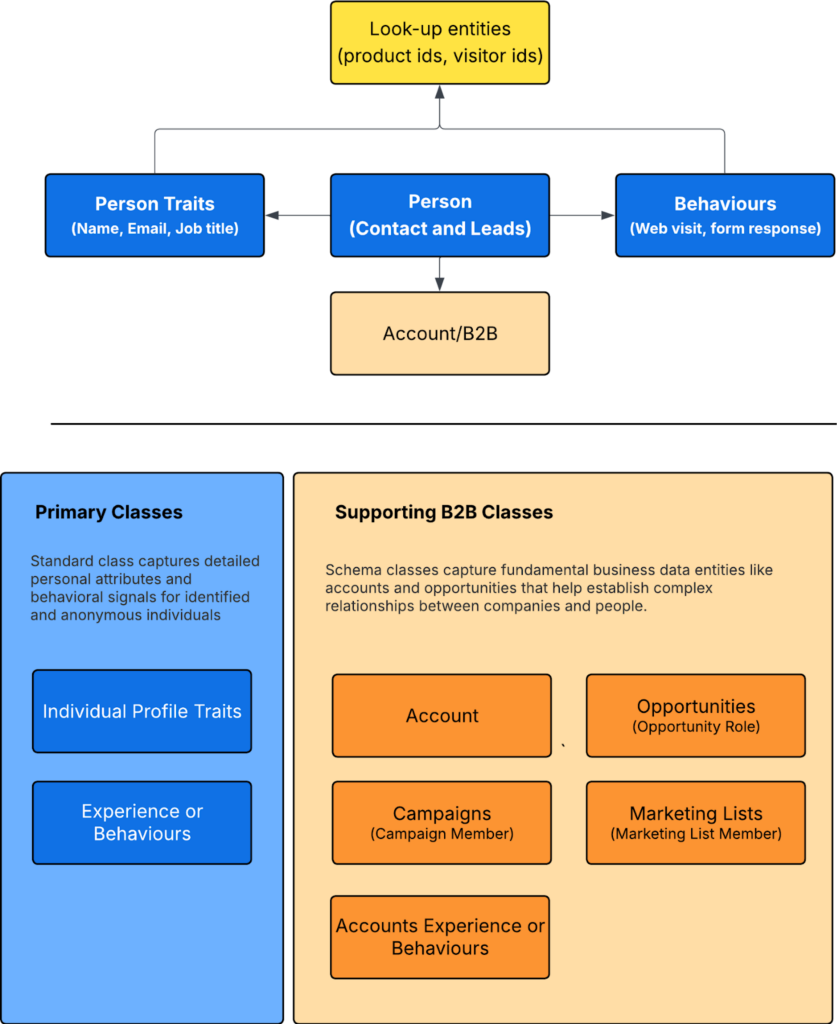
Unlike B2C models that flatten everything to an individual profile, RT-CDP B2B uses specific XDM classes to construct a B2B Graph of multiple relationships. XDM’s B2B schema classes—Account, Opportunity, and Person—enable this. Together with relationship descriptors, they provide the structural backbone for the B2B Graph.
- Structure: The B2B Graph dynamically links individual profiles (People) to account profiles (Companies) and Opportunities.
- Relationships: Crucially, it supports many-to-one and many-to-many relationships. This allows the system to recognise that ‘Jane Doe’ is not just a person; she is a ‘Decision Maker’ on the ‘Q3 Enterprise Deal’ opportunity for ‘Acme Corp’.
- Connection: This structural integrity ensures that marketing signals from one individual, such as Jane Doe viewing a specific product data sheet, can instantly influence the overall account score for the entire buying group, providing sales and marketing with a shared, real-time reality.
Designing the Identity Strategy Before You Touch Data
In most enterprise deployments we see, the biggest time sink is not the data ingestion itself, but the failure to agree on an identity strategy upfront. This is the single most critical, architect-level decision you will make. It determines how your data is stitched together and, ultimately, if your personalization will work.
The core challenge is defining your Identity Namespaces and their precedence:
- Primary vs. Secondary Namespaces: First, you must decide which identifier is the primary key. For example, in B2B, the Email Address and CRM ID are essential primary namespaces. In contrast, secondary namespaces like cookie IDs track behavior until the individual is known.
- CRM ID vs. Email Precedence: Next, consider what happens when an individual changes roles. Typically, the B2B default should be a clear hierarchy that prioritizes the CRM ID as the strongest link.
- Account Stitching Challenges: The B2B Graph is what performs the account stitching, linking multiple people (IDs) to a single account (ID). Pitfalls here include poor quality account IDs in the source systems or insufficient standardization of the company name field. The platform is powerful, but it cannot fix fundamentally broken source data, a core principle JTF addresses in its data and analytics strategy.
- Duplicate Identity Pitfalls: If your data sources (e.g., two different legacy CRMs) push the same person with two different IDs, the identity graph can inflate, creating two partial profiles instead of one unified one. A rigorous namespace strategy and de-duplication rules, defined in Phase 1, are essential to avoid this.
Ingestion and Identity Resolution
The platform uses a dual ingestion strategy to manage history and real-time speed. Batch Ingestion handles the heavy lifting of historical data (e.g., ten years of CRM logs). Streaming Ingestion captures the ‘now’, web and app behaviours are captured in real-time via the Edge Network, allowing the system to react to a pricing page visit within milliseconds.
The final piece of the puzzle is the Identity Graph. This is where the ‘magic’ of stitching the ghost (anonymous cookie ID) to the machine (known email address) occurs. The dynamic Identity Graph records relationships between identifiers as they occur. When a user clicks a tracked email and lands on your website, the system links those two identities. The flow then becomes:
$$Data\ Sources \rightarrow \textbf{Identity Graph} \rightarrow \textbf{Real-Time Profile} \rightarrow \textbf{Destinations}$$
This process results in a Real-Time Profile, a living, breathing profile hydrated with all known and anonymous attributes, which is then activated to channels like Marketo Engage, LinkedIn, or Adobe Journey Optimizer (AJO).

Real-Time Action: Moving from Insight to Orchestration
Building a Real-Time CDP is not about replacing your MarTech Tech stack; it is about orchestrating it. The most powerful deployments leverage what is often called the ‘Golden Triangle’ of the Adobe B2B Tech stack: Marketo Engage, RT-CDP, and AJO B2B Edition. JTF has refined this architecture across global implementations to ensure maximum impact.
The ‘Golden Triangle’ for B2B Success
- Marketo Engage: The engine for Lead Management and scoring. It captures the initial hand-raising and manages the known lead lifecycle.
- Adobe RT-CDP B2B Edition: The brain for Data Unification. It ingests data from Marketo Engage, combines it with anonymous web traffic and Salesforce data, and resolves the identities via the B2B Graph.
- Adobe Journey Optimizer (AJO) B2B Edition: The muscle for Omnichannel Activation. It uses the unified profile from RT-CDP to trigger personalization across email, app, and web, focusing on the entire buying group, not just a single lead.
The Power of Bi-Directional Sync: Generating Marketing Qualified Buying Groups
In this ecosystem, data does not just sit in one place; it flows bi-directionally, creating a closed loop that aligns sales and marketing.
- Inbound Flow: Marketo Engage pushes lead scores, program statuses, and activity logs into RT-CDP. This feeds the B2B Graph with crucial ‘known’ engagement data.
- Outbound Flow & Activation: This is where the real value is realized. RT-CDP calculates complex segments, such as ‘High Intent Accounts’ (any account with three or more individuals who have visited the pricing page in the last seven days and have an open opportunity in Salesforce). It then pushes these segments back to Marketo Engage as static lists or directly to AJO B2B Edition as journey triggers.
This allows Marketo Engage to fire off specific email nurtures or AJO to launch a coordinated outreach journey based on web behaviour it could not previously see on its own. It transforms the concept of an MQL (Marketing Qualified Lead) into a far more accurate and valuable Marketing Qualified Buying Group (MQBG), which is the most precise and cost-effective success metric for modern B2B demand generation. The MQBG is a group of key stakeholders inside a target account that is responsible for making a purchasing decision for a specific product, giving sales a pre-qualified opportunity.
Operational Friction: When Lifecycle Design Breaks Segmentation
While the bi-directional sync is powerful, it is not set-and-forget. Operational friction often occurs when poor lead lifecycle design in Marketo Engage exists. Consequently, this breaks segmentation in the RT-CDP.
For example, if the Marketo lifecycle programmed frequently updates the “Lead Status” field, sending a constant stream of low-value, duplicate status updates to the RT-CDP, this can:
- Inflate the Profile Store: Too much noise makes it harder to isolate truly meaningful, high-intent events.
- Break Segmentation: If a segment is built on the most recent interaction, and that interaction is a redundant status change rather than a pricing page visit, the segment will be based on inaccurate data.
The architectural pattern we consistently recommend at JTF is to be highly disciplined about the data points that flow from Marketo Engage into the RT-CDP. Send only high-signal engagement activity (e.g., “demo request,” “webinar attended,” “key product page viewed”) and use the RT-CDP to calculate the overall Account Intent Score, rather than simply replicating all of Marketo’s internal scoring logic. This grounds the architecture in real-world operational sanity.
Real-World Example: Paid Media Suppression
For instance, a classic pilot use case proves the immediate return on investment (ROI) of this architecture.
- Goal: Stop wasting advertising spend on existing customers.
- Action: First, ingest all ‘Closed Won’ Salesforce customers. Then, create a segment for those who are not visiting.
- Activation: Next, push this segment to LinkedIn or other paid media destinations to suppress ‘Book a Demo’ ads.
- Result: Consequently, you achieve immediate cost savings. This proves the integration is working and that the unified data is actionable. Ultimately, this is low-hanging fruit with high visibility for the finance team.
Behind the Build: Mistakes I Made and Lessons Learned
In the journey of architecting a Real-Time CDP solution, there are common mistakes that senior leaders must anticipate and navigate. These are the hard-won lessons from the project trenches that can accelerate your time-to-value and ensure your investment delivers on its promise.
CDP vs. Data Lake: What I got wrong the first time
I remember my first large-scale deployment where we spent six weeks in a technical debate about the Data Lake versus the RT-CDP profile store. My initial thought was, “If the CDP can ingest data from all sources, why do we need the Data Lake at all? Isn’t it just a more expensive duplication?”
This was a fatal misunderstanding of purpose. What I got wrong was confusing storage with action.
- Data Lake: The master of storage and deep analysis. It holds petabytes of raw, historical data and is optimized for complex, batch-style queries by data scientists. We use it for long-term historical archives and deep, non-time-sensitive predictive modelling.
- CDP (Profile Store): The master of action. Its profile store is optimized for speed, sub-second lookups required to instantly personalize a web page or trigger an event-based journey.
If you try to use your Data Lake for real-time personalization, the latency will kill your conversion rates. The CDP is the real-time, activation layer that sits atop your entire Tech stack to make data actionable, while the Data Lake remains the historical archive. They are complementary, not competing, systems.
Data Hoarding: What I would design differently now
In my first major schema design, I attempted to ingest everything. I included ten years of sales logs and every web click since the company was founded. My logic was simple: “We need all the data to unify the view.” This approach immediately choked the system and overwhelmed the team. It drove up costs and complexity without delivering value.
Instead, I now recommend a ‘Use Case First’ approach. Specifically, only ingest value-add data that aligns with your enterprise strategy. For example, if a data point doesn’t calculate a segment or trigger a journey, leave it in the lake. Furthermore, I now stress the importance of discipline. Therefore, you should focus your initial integration on a minimum viable data set. Ultimately, this ensures you can successfully execute your Phase 2 and Phase 3 pilots.
Governance and Consent as a Foundation
In the excitement of unification, it is easy to overlook the legal and ethical requirement of data governance. Before any data is activated, Phase 1 must include setting up the Data Usage Labeling and Enforcement (DULE) framework. You must ensure you are not activating data that violates your privacy policies or customer consent preferences. The RT-CDP provides the tools for this, but the organization must define the rules. Ignoring this creates significant legal risk and can permanently erode customer trust.

Download
Data Hygiene “Must Haves”
Download our Step-by-step checklist for Marketo migration.
Scaling Personalization with RT-CDP
The ultimate goal of a unified data architecture is to power a superior, scalable customer experience. The Real-Time CDP is the engine that moves personalization beyond basic segmentation to truly dynamic, moment-to-moment interactions that drive customer loyalty and increase conversion.
Personalization is not a content problem. It is a data relationship problem
Most companies remain in the early stages of personalization, basing experiences on assumptions or simple, large demographic segments. This is no longer enough. Anonymous visitors and known customers alike expect a highly relevant, personalized experience starting from the very first touch. To deliver this, you must shift your focus from simply tagging content to mastering the relationships between your data entities (Person, Account, Opportunity) via the B2B Graph.
RT-CDP B2B Edition closes this gap. It executes sophisticated, cross-channel use cases impossible with siloed tools.
- Same-Page, Next-Hit Personalization: Use RT-CDP with Adobe Target to achieve true real-time personalization. Imagine an anonymous visitor lands on your homepage and then visits a support page. RT-CDP instantly updates their profile with a ‘High Intent for Support’ attribute. This data is pushed to Target to change the content on their very next hit. For example, you can show a self-service resource rather than a marketing eBook.
- Account-Based Optimization: The B2B Graph drives personalization through collective buying group behaviour. For example, if three people from ‘Acme Corp’ show high engagement, you can personalize the entire website for that account. This even applies to new, anonymous visitors based on the specific products they are researching.
Unexpected Value: What I discovered about churn prediction
One of the most powerful examples of a mature RT-CDP deployment I have personally overseen comes from outside of pure marketing, demonstrating the true value of a unified view.
The Customer Success team’s CRM showed ‘Green’ health scores based only on scheduled surveys. The reality, however, was hidden. The CRM was an island. It only told us what we asked it to. It remained silent on real-time customer behavior.
The solution was the CDP. It ingested web and app behavior to track the Account Activity signal, specifically a drop in login frequency combined with visits to the ‘cancellation policy’ page. This combination of signals, invisible to the CRM alone, allowed the customer success team to predict churn risk three months before the renewal date. We used this insight to enable proactive intervention, saving a critical business relationship. This, for me, is the definition of a Real-Time CDP becoming a Single Source of Truth and Action for the entire organization.
Implementation Roadmap: Phases of Maturity
A Real-Time CDP implementation is not a ‘big bang’ launch; it is a phased, measured evolution that aligns people, process, and technology. JTF recommends a phased approach to ensure quick wins and sustained momentum.
Phase 1: Foundation (Months 1–3) – The Organizational Blueprint
This is the ‘measure twice, cut once’ phase. It builds a stable, compliant data structure and establishes your operational model.
- Schema Design: Define your B2B XDM schemas for Accounts, People, and Opportunities.
- Identity Namespaces: Define a hierarchy for identifiers like Email, CRM ID, and cookies.
- Governance and Consent: Set up your Data Usage Labeling and Enforcement (DULE) framework for privacy compliance.
- Data Governance: Establish a clear RACI matrix. Distinguish roles for Data Engineering, MarTech Operations, and the CDO.
- Marketing Ops vs. Data Engineering Roles: Clearly define responsibilities (e.g., Marketing Ops owns activation; Data Engineering owns ingestion and schema modelling).
- Change Management: Conduct workshops to align teams on MQBG definitions. Build trust in the RT-CDP data.
Phase 2: The Pilot (Months 3–5)
The goal of the pilot is to prove value fast with one high-impact, achievable use case.
- Single Channel Activation: Use a simple, measurable case like Paid Media Suppression (suppressing ads for closed-won customers) to demonstrate ROI.
- Process Alignment: Align marketing and sales around a single, agreed-upon segment definition.
Phase 3: Orchestration (Month 6+)
Once the pipes are connected and value is proven, you can scale. Reach true omnichannel orchestration
- Cross-Channel Journeys: Link AJO B2B Edition and Marketo Engage, using RT-CDP to detect a ‘Buying Group’ and trigger a coordinated outreach across channels.
- Offline Data Ingestion: Ingest crucial data like call center logs or event attendance. This completes both the profile and the B2B Graph.
This phased evolution ensures the implementation is more than a technology project. It is a sustainable organizational transformation that progressively delivers greater business value..
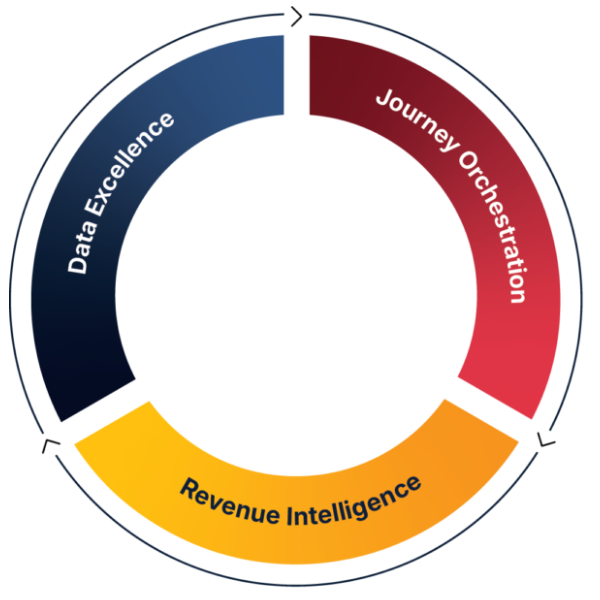
JTF Revenue Acceleration Loop
How Real-Time CDP B2B Edition Powers the Revenue Acceleration Loop
For many Marketing Operations teams, shifting to a Real-Time CDP B2B single source of truth does more than just unify data – it reshapes the very foundations of how your revenue engine operates.
Within the Revenue Acceleration Loop, this isn’t a peripheral concern. Consequently, it directly drives the stability and performance of your three core pillars: Data Excellence, Journey Orchestration, and Revenue Intelligence.
Conclusion
The era of fragmented B2B data must end. By implementing a Real-Time CDP B2B Edition, you lay the foundation for a unified profile and a connected organization. It shifts your teams from reacting to siloed history to proactively driving action based on the real-time intent of the entire buying group. The journey requires commitment, but the reward is a system that accelerates revenue, increases win rates, and delivers an exceptional, consistent customer experience.
Take the next step
Want help applying this?
Book a marketing automation consultation with JTF
Connect with Charlie on LinkedIn.
Frequently Asked Questions
Adobe Real-Time CDP B2B Edition is a customer data platform purpose-built for B2B. Unlike B2C models, its B2B Graph architecture models the complex relationships between people, accounts, and opportunities. It ingests data from CRMs and web analytics to resolve identities in real time. Consequently, it creates unified profiles for immediate cross-channel activation.
A CRM is contact-centric and lacks buying-group logic. In contrast, a data warehouse excels at batch reporting but cannot deliver sub-second lookups for personalization. Real-Time CDP combines CRM relationship modelling with the speed of a profile store. Specifically, it is optimized for immediate activation across marketing, sales, and customer success channels.
The B2B Graph is a structural framework mapping relationships between people, accounts, and opportunities. Unlike B2C models, it links individual behavior to account-level intent. Therefore, your marketing team can target the entire buying committee effectively.
An MQBG is the B2B evolution of the traditional MQL. Instead of qualifying individuals, it identifies key stakeholders within an account who collectively demonstrate intent. Ultimately, this is a more accurate metric because committees, not individuals, make B2B purchasing decisions.
Identity resolution stitches multiple identifiers – like cookie IDs, emails, and CRM IDs – into a unified profile. In B2B, this is critical because prospects interact through many channels before identifying themselves. Furthermore, the Identity Graph resolves these identities in real time to make behavioral history immediately actionable.