


















The Illusion of Progress: Why Linear Marketing Fails
Most B2B marketing organizations still operate with a linear mindset.
We talk about funnels and track stages, measuring activity at each step in the hope that revenue falls out at the bottom. It rarely does.
The traditional funnel is leaky because revenue systems are not linear. Instead, they are cyclical. Yet, most organizations structure their teams as if campaigns and data sit in separate silos.
Then the CFO asks a simple question:
“What did this campaign actually deliver?”
And the answer is often activity.
Clicks are up. Traffic is up. Engagement is improving.
But revenue?
Unclear.
This is not a talent issue. It is a systems issue.
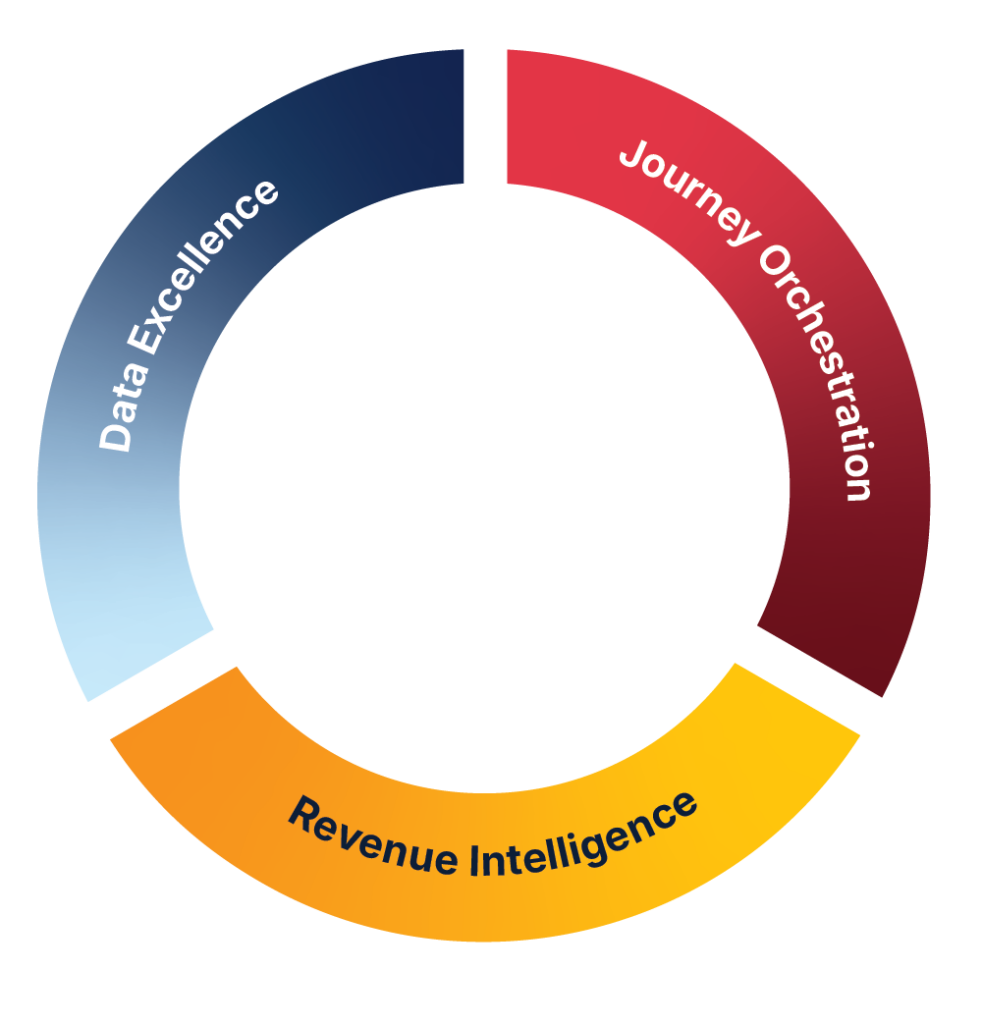
High-performing revenue engines do not happen by accident. They are built on a cyclical ecosystem of:
- Data Excellence
- Journey Orchestration
- Revenue Intelligence
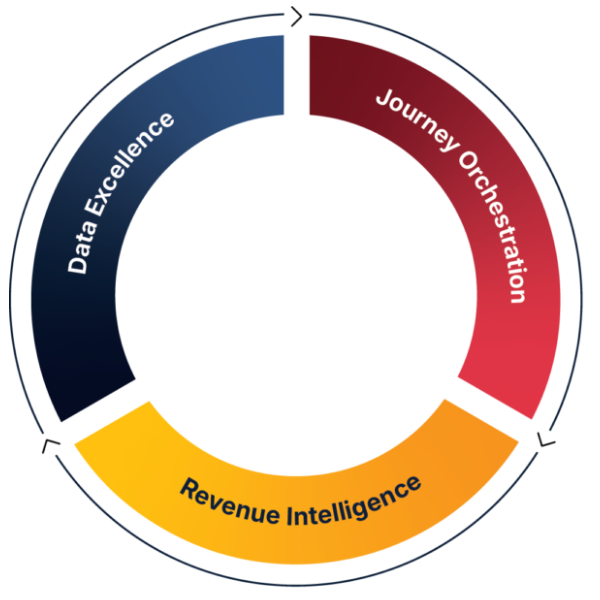
We call this the Revenue Acceleration Loop.
When one breaks, revenue slows. Conversely, when they operate as a connected system, marketing becomes commercially undeniable.
The AI Acceleration Risk: Speed Without Structure
AI has changed the pace of the conversation.
We can now generate content, personalize experiences and deploy campaigns at a scale that was impossible two years ago. Agentic AI promises autonomous optimization across channels.
But AI is a multiplier.
If your foundation is wrong, it multiplies the wrong thing.
Many CMOs are over-indexing on orchestration because that is where they are strongest. They are customer experience experts. They understand narrative, brand, buying journeys.
They are not systems architects. Nor should they have to be.
Avoid the trap of layering AI on top of fragmented identity, inconsistent governance, and unreliable reporting. Building on a broken foundation won’t create a competitive advantage; it only accelerates confusion.
CMOs must stay relentlessly focused on the metrics that matter:
Conversations.
Conversions.
If AI does not help generate the right conversations with the right buying groups and improve conversion through the pipeline, it is noise.
The only way to ensure AI works is to stabilize the structure it operates within.
That structure is the Loop.

Step One: Data Excellence – The Foundation of Trust
Data Excellence is not a technology project. It is a commercial discipline.
It means building a trusted, unified foundation that connects account-level and person-level identity across your ecosystem. It means eliminating silos so every engagement, every signal and every opportunity sits within a coherent structure.
Without this, personalization is guesswork.
We once launched a large-scale personalized ABM programme. The creative was strong. The orchestration was sophisticated. The targeting logic looked sound.
It failed.
Why?
Identity resolution was flawed. Senior executive messaging was landing with junior technical users. Buying group roles were misclassified. The experience felt disconnected because the underlying data was.
The lesson was painful but clear:
You cannot orchestrate what you cannot reliably identify.
Data hygiene is not a one-time cleanse. It is an operating rhythm. Governance, enrichment, validation and alignment must be continuous.
At board level, data trust is budget trust.
If the numbers are questionable, the investment conversation stops. On the other hand, if the data is credible, marketing earns the right to scale.
Step Two: Journey Orchestration – The Engine of Engagement
Once the foundation is stable, orchestration becomes powerful.
This is where marketing teams naturally focus. For example, they move from batch-and-blast to behavior-based engagement. Furthermore, they coordinate touchpoints across email, web, and paid media. Consequently, they can design role-specific journeys for complex buying groups
But true orchestration is not about pushing messages. It is about responding to behavior in context.
AI now makes this scalable.
It is no longer humanly possible to map every permutation of industry, role, stage and intent manually. AI allows us to tailor engagement dynamically, adjusting messaging and sequencing based on real-time signals.
The key is alignment.
Every channel must sing from the same sheet of music. The website experience, the advertising layer, sales outreach and lifecycle communications must be driven by the same identity spine.
And throughout, we return to the commercial question:
The key question is: are we generating meaningful conversations with the right people?
Are those conversations progressing to conversion?
If orchestration does not improve pipeline velocity or conversion rates, it is activity without impact.

Download
Master Your Revenue Foundation
You cannot orchestrate what you cannot reliably identify. Before layering AI or complex journeys onto your system, ensure your data is commercially credible.
Download our guide to the 5 data hygiene essentials that turn your Marketo instance into a high-performance revenue engine.
Step Three: Revenue Intelligence – The Proof That Wins the Board
Revenue Intelligence is where marketing credibility is won or lost.
For too long, we have relied on language like “influence” and “engagement.” That is not enough in the boardroom.
The shift is simple:
From: “We believe this influenced sales.”
To: “This program contributed £2M to pipeline acceleration and improved conversion by 14 percent.”
But there is a trap here as well.
I once walked into a budget discussion armed with a sophisticated attribution model. It was technically sound and visually impressive.
The CFO ignored it.
It was too complex.
That meeting changed my approach permanently.
Revenue Intelligence must be commercially simple. Inputs and outputs. Activity and conversion. Investment and return.
Closed-loop visibility should answer three questions:
- What activity generated qualified conversations?
- How did those conversations convert?
- Where should we invest the next pound?
When done properly, Intelligence feeds back into Data Excellence. It tells you which signals matter, which roles convert fastest and which channels accelerate deals.
The Loop closes. And then it refines itself.
JTF Revenue Acceleration Loop
Does Your Revenue System Support Your Ambition?
A disconnected stack creates “activity noise” rather than revenue impact. At JTF Marketing, we help you audit and reconnect your Data, Orchestration, and Intelligence layers to ensure your marketing engine is commercially undeniable.
Translating the Loop for the Board
Non-marketing executives do not need platform terminology. They need commercial clarity.
Position the Loop in their language:
Data Excellence = Risk Mitigation and Efficiency
We are not wasting budget targeting the wrong accounts or misclassifying buying roles.
Journey Orchestration = Market Penetration and Speed
We are reaching and progressing buying groups faster than competitors.
Revenue Intelligence = Investment Security
We know where every pound is working and where to double down.
Ultimately, anchor the narrative in conversations and conversions above all else.
Everything else is supporting evidence.
Behind the Build: What I Learned the Hard Way
Three lessons shaped how I view revenue architecture.
First, structure before scale. Our failed ABM initiative proved that no amount of creativity compensates for flawed identity.
Second, AI is not the enemy of authenticity. I was initially sceptical that generative tools would make us sound robotic. The opposite proved true. With the right data, AI allowed us to be more specific, more relevant and more aligned to buying roles than manual effort ever could.
Third, simplicity wins trust. Attribution models do not need to be academically perfect. They need to be commercially credible.
In each case, the breakthrough came when we focused less on marketing sophistication and more on system integrity.
The Continuous Advantage
The Revenue Acceleration Loop is not a campaign framework. It is an operating model.
Intelligence refines Data.
Data strengthens Journeys.
Journeys drive measurable Revenue.
And the cycle continues.
AI will continue to accelerate what is possible. The question is whether it will accelerate clarity or chaos.
If your metrics feel disconnected from revenue, if your board challenges your numbers or if your AI ambitions are running ahead of your data foundation, your Loop may not be broken.
It may simply be disconnected.
That is solvable.
At JTF, we help organizations audit and reconnect their Data, Orchestration and Intelligence stack so marketing becomes a measurable revenue driver, not a cost centre.
The question is not whether you need better campaigns.
It is whether your revenue system is built to support them.
Conclusion: From Linear Activity to Cyclical Impact
The shift from being a “cost center” to a “revenue driver” doesn’t happen by launching more campaigns or buying more AI tools; it happens by fixing the system they run on. As Andy Mullings illustrates, the Revenue Acceleration Loop turns the traditional, leaky funnel into a self-reinforcing engine of growth.
By prioritizing Data Excellence to build trust, using Journey Orchestration to meet buyers in context, and leveraging Revenue Intelligence to prove commercial value, marketing leadership can finally provide the board with the clarity they crave.
The takeaway is simple: Don’t let AI accelerate your chaos. Stabilize your structure, align your identity, and focus on the only two metrics that truly move the needle: conversations and conversions. When your data, journeys, and intelligence operate as a connected loop, your marketing impact becomes commercially undeniable.
Take the next step
Is your revenue system built to support your growth?
Don’t let your AI ambitions run ahead of your data foundation. Whether you need to fix your identity resolution or prove your impact to the board, we can help you close the Loop.
Connect with Andy on LinkedIn.
Frequently Asked Questions
It is a cyclical operating model consisting of three pillars: Data Excellence (the foundation), Journey Orchestration (the engine), and Revenue Intelligence (the proof). It moves marketing away from linear funnels toward a connected system where data and intelligence continuously refine each other to drive revenue.
AI is a multiplier. If it is layered on top of fragmented data, inconsistent governance, or “leaky” funnels, it simply accelerates confusion and multiplies errors. For AI to work, the underlying data structure and identity resolution must be stable.
Avoid “vanity metrics” like clicks and engagement. Instead, use “commercially simple” language centered on two things: Conversations (meaningful engagement with the right buying groups) and Conversions (how those conversations progress through the pipeline).
Scaling before the structure is ready. Many programs fail because of flawed identity resolution—where messaging intended for senior executives lands with junior users because the underlying data sits in disconnected silos.